Understanding Cartoon Charves: A Detailed Guide to This Unique Line-Style Font
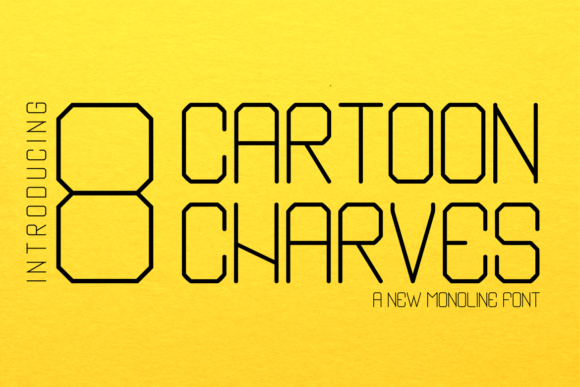
In the vast landscape of digital typography, finding a font that balances distinctiveness with readability can be a significant challenge. Cartoon Charves presents itself as a compelling option for designers and content creators who need a typeface that commands attention without sacrificing clarity. This line-style techno sans serif font occupies a fascinating space between traditional categories, offering a retro aesthetic that feels both familiar and refreshingly modern. For adults exploring design resources, understanding the specific characteristics and ideal applications of Cartoon Charves is essential for making an informed choice.
At its core, Cartoon Charves is defined by its line-style construction. This means the letterforms are not solid blocks of ink but are instead composed of clean, consistent outlines. This technique gives the font a technical, almost diagrammatic quality. The "techno" aspect of its description refers to its geometric precision and mechanical feel, common in fonts associated with engineering, futurism, or digital interfaces. However, what makes Cartoon Charves particularly interesting is its dual nature. Despite being classified as a sans serif—lacking the small decorative strokes at the ends of letters—its unique character design often creates an impression of serifs. The careful weight distribution and terminal shapes of certain letters, like the 'C' or 'S', can mimic the visual rhythm of serif typefaces, offering a subtle classicism within a modern framework.
Analyzing the Visual Identity and Readability
The primary strength of Cartoon Charves lies in its unique visual identity. In a market saturated with standard sans serifs like Helvetica or geometric fonts like Futura, Cartoon Charves offers a distinct alternative. Its retro or vintage vibe is not tied to a specific decade but rather evokes a timeless sense of technical drawing and classic animation titling. This makes it exceptionally well-suited for projects that aim to convey nostalgia, craftsmanship, or a hand-drawn technical quality. Think of vintage product packaging, retro-themed website headers, or logo designs for creative studios. The font's personality is strong, which means it can establish a brand's tone quickly and effectively.
Regarding readability, Cartoon Charves performs admirably for display and headline purposes. The clear, open letterforms and consistent line weight ensure that words are easily deciphered at larger sizes. Its uniqueness does not come at the cost of legibility in these contexts. However, like many display fonts with strong character, its suitability for long-form body text is limited. The very features that make it stand out at a headline size—the outlined style and distinctive shapes—can become visually fatiguing and reduce reading speed in dense paragraphs of smaller text. Therefore, a practical approach is to use Cartoon Charves for impact and pair it with a more neutral, highly readable sans serif or serif for body copy.
Comparing Cartoon Charves to Similar Font Categories
When evaluating Cartoon Charves, it helps to compare it to broader font categories to understand its fit. It is not a direct replacement for a standard workhorse sans serif. Fonts designed for maximum neutrality and readability in body text, such as Open Sans or Roboto, prioritize function over distinct style. Cartoon Charves makes the opposite trade-off: it prioritizes distinctive style for specific applications. If your project requires a font that disappears into the background to let the content shine, Cartoon Charves is likely not the right tool.
Compared to traditional serif fonts like Times New Roman or Garamond, Cartoon Charves lacks the organic, calligraphic heritage. Serifs are often chosen for their readability in print and their formal, authoritative tone. Cartoon Charves offers a technical, constructed alternative. It can achieve a vintage feel without the specific historical baggage of a classic serif, making it more versatile for modern retro designs.
Where it finds its true niche is in comparison to other display and novelty fonts. Many novelty fonts sacrifice readability for pure aesthetic effect, becoming almost pictographic. Cartoon Charves maintains a higher degree of typographic integrity. Its letters are still clearly recognizable as an alphabet, but with a pronounced stylistic filter. This makes it a more practical choice for logos, branding, and user interfaces where clarity of letterforms is non-negotiable, even while making a bold statement.
Practical Applications and Best-Fit Scenarios
Identifying the best use cases for Cartoon Charves is key to leveraging its strengths. It shines in contexts where a retro-technical or vintage-modern aesthetic is desired.
- Branding and Logos: For businesses in creative fields, retro gaming, specialty craftsmanship, or tech startups with a playful edge, Cartoon Charves can form the cornerstone of a memorable visual identity. Its outline style can be easily adapted for single-color applications, embossing, or screen printing.
- Poster and Title Design: Event posters, movie titles, book covers, and album art can benefit from its arresting presence. It communicates energy and style effectively at scale.
- UI/UX Elements: Used sparingly for app headers, button labels, or menu titles, it can inject personality into a digital product. Its geometric construction often ensures good alignment and spacing in interface grids.
- Packaging and Merchandise: Product labels, especially for food, beverages, or consumer goods aiming for a "classic" or "artisanal" look with a modern twist, can use Cartoon Charves to stand out on shelves.
Conversely, there are situations where alternative choices are more appropriate. For academic papers, legal documents, or lengthy e-books, a traditional serif or a highly readable sans serif is preferable. For ultra-minimalist designs where typography should be entirely neutral, Cartoon Charves would be disruptive. Projects targeting a very young children's audience might require a softer, more rounded typeface, whereas Cartoon Charves has a more mature, technical feel.
Making the Decision: Key Factors to Consider
Choosing Cartoon Charves involves weighing several practical factors. First, consider the project's tone and audience. Does the target demographic respond well to retro or technical aesthetics? Is the goal to appear innovative, nostalgic, or uniquely creative? If yes, this font aligns well. Second, evaluate the medium of application. Its outlined nature may render differently on very low-resolution screens or in very small print sizes, where lines could blur. Testing it in the actual environment is crucial. Third, think about font pairing. Cartoon Charves will need a complementary partner for body text. Look for a clean, simple sans serif that shares a similar x-height or geometric foundation to create visual harmony without competing for attention.
Finally, assess the licensing and technical specifications. Ensure the font license covers your intended use—whether for a website, printed materials, or merchandise. Check for the availability of necessary character sets, such as numbers, punctuation, and any required language support. A font is only as good as its usability within your specific workflow.
In summary, Cartoon Charves is not a universal solution but a specialized tool. Its value lies in its ability to merge a techno-sans-serif framework with a retro sensibility